I still remember standing on the first tee box, my heart pounding so loud I was sure everyone in the clubhouse could hear it. My hands were sweating, my knees felt weak, and I had absolutely no idea what I was doing. I kept telling myself, "Just don't embarrass yourself. Just make contact."
That was me three years ago. Today, I want to share everything I wish someone had told me before I started. These golf tips for beginners aren't complicated theories from stuffy textbooks. They are real-world, practical lessons that helped me fall in love with this crazy, frustrating, beautiful game. If you are just starting out, grab a club and get comfortable. We are going to fix your game together.
Why I Decided to Write This Guide for New Golfers
As I was initially searching to get assistance, I came across millions of videos and articles. A majority of them had the assumption that I was aware of what a neutral grip was or how to shallow the plane. I didn't. I was lost. I recall reading an interview of Dan Brown, an American Golf ambassador and touring pro.
This is one thing that I have remembered well: It is a bit intimidating when trying something new, and that is the case with a game such as golf, which seems more technical and full of unwritten rules. He was right. It was as though I had arrived at a party and they all knew the secret handshake but I was not.
This guide is the handshake. I wrote this because I only hoped it would be a simple, friendly, and to the point article which I badly needed three years ago. Let's dig in.
You may also read :- How to Improve Golf Swing Consistency: Tips for Every Golfer
Golf Tips for Beginners: Getting Started Without Feeling Lost
We cannot talk swinging hard before we talk about starting smart. Most of the novices end up dropping out due to overexertion on oneself.
My First Trip to the Driving Range (And What I Learned)
I entered the driving range with no plan and a bucket of balls. I now began swinging to the best of my ability. At ten years old, I was exhausted with a sore arm, and I was also frustrated. I soon came to know that one cannot practice without a plan, just wasting time.
According to top coach, Mark Blackburn, the No.1 Coach in America according to Golf Digest, the best way to start is by first warming up before you can even pick up a club. Complete some jumping squats or lunges. Get the blood moving. And something athletic is happening to your body, although it may not be feeling it yet.
Should You Take Lessons Right Away?
Many of them told me, Go out there and play, you will know what to do. I didn't figure it out. I simply learnt how to behave bad. The most common error that beginners in golf make is that they think that only serious players take lessons. That is totally the opposite.
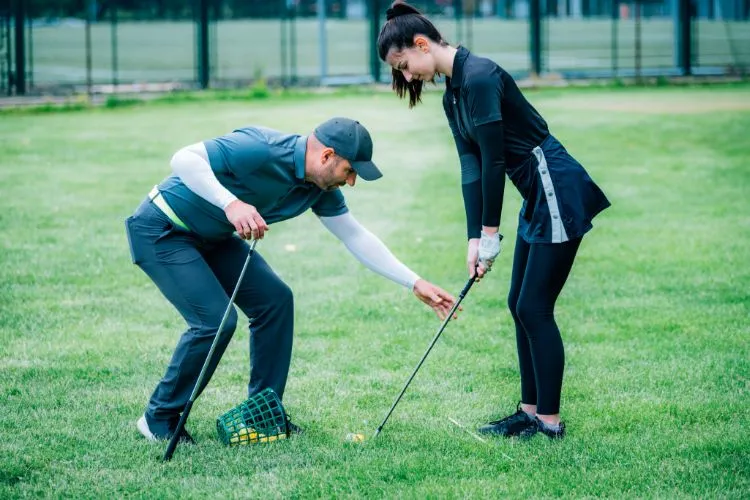
I had a 30-minute lesson with a local pro. During that half hour, he solved one of the grip problems that would have taken me months to solve by myself. Lessons on golf as a beginner do not involve making you a pro. They are concerned with ensuring that you do not form bad habits that are difficult to quit in future.
The Foundation: Setup and Grip for Beginners
The roof will be crooked in case the house is not level. Your swing is the same way.
How I Learned to Hold the Club (Without Strangling It)
My first grip was terrible. I had the club as though I were striving to smash a soda can. My forehead and wrists were white, my forearms stiff.
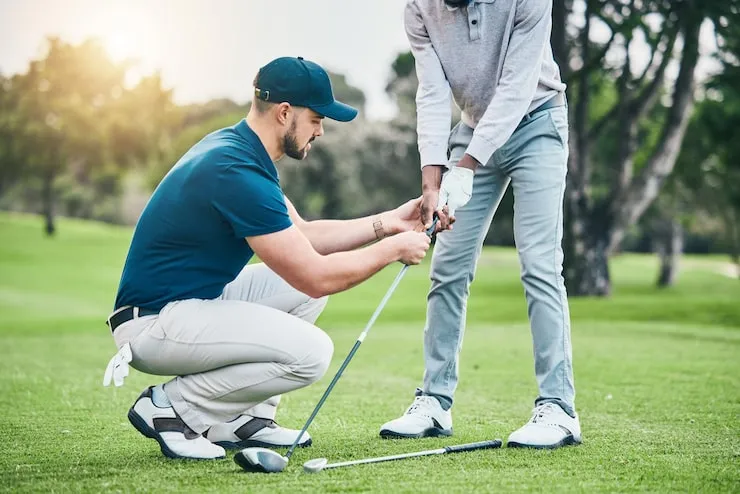
The club is only attached to a proper grip. It is simple enough according to Dan Brown: with right-handed golfers, the left hand is first, and the handle should be held in the fingers, not in the palm. Look down and you will see that there are two or three knuckles to your left hand. The right hand will subsequently cover the left hand and the palm towards the target.
Posture and Stance: Standing Like an Athlete
My posture was to stand straight up as though waiting to take a bus. Then why I continued to top the ball, I wondered. Good posture implies bending at the hips and not at the waist. Pop out your butt a bit. Let your arms hang naturally. Your knees must be suet--as though you were about to receive a basketball, and not crouching over a heavy box .
For your stance:
- Short irons: Feet are slightly smaller than the shoulders.
- Driver: Feet are no more than shoulder-width.
The "Head Down" Myth That Almost Ruined My Swing
All people told me, Keep your head down! So I did. I held my head very much down so that my chest was towards the ground, and I was in no way able to rotate. This is the fact: remaining low is among the worst habits that can be formed. Watch any pro on TV. Are they done with their swing and look at the grass? No. Their chest is high, the hips towards the target and the eyes to chase the ball.
Beginner Golf Swing Tips: Making Solid Contact
You don't need a perfect swing. You require a swing that will strike the ball with a regularity.
Why I Stopped Trying to "Scoop" the Ball
Month after month I was trying to enable the ball to get into the air. I would turn my back shoulder and attempt to pick it like a tennis ball. It never worked. The club is made to elevate the ball to the air. You don't need to help it. You have to strike the ball with the ground first. When you are ironing, you want to get a little divot following the ball. In other words, you strike down the ball and it is up.
The Simple Takeaway Drill I Use Every Time
I would jerk the club up with my hands whenever I initiated my backswing. It upset the balance of everything. The easy solution: Swing, gently, between hip-high and hip-high. Turn your shoulders and hips. Make the club go round your body, not like you are picking up a suit case.
Understanding Your "Shot Pattern"
And this is the bitter truth: you will hardly ever strike the ball straight. The shots of most golfers are naturally curved one is a slight fade (to right) or a slight draw (to left). According to GOLF Top 100 Teacher Debbie Doniger, you are supposed to learn how to play with your natural shot shape.
When you have the tendency of punching the ball off, point slightly to the left and the ball will curve towards its centre. Quit attempting to make it straight. Do not struggle with your body.
Golf Course Strategy for Beginners: Playing Smart
It is possible to strike the ball and score dismally making silly choices. It is in this way that you can think round the course.
Aim for the Green, Not the Flag
This was huge for me. I would stand and look at the flagstick and tell myself, I am going to hit it just by the hole. Then I would be ten yards off and in a bunker or a tree. Newcomers ought to target the middle of the green. You are likely to be on the putting green even then you fail to hit your target. It is much better to make a 40-foot putt than to chip out of a sand trap.
How I Stopped Trying to Be a Hero
The first thought that came to my mind when I struck a bad shot into the trees was, I can still make it! I will smash it up through that small hole! Spoiler: I never made it. I have hit yet another tree and made the score worse.
Golf rewards patience . Whenever you happen to be in trouble, simply get back in the fairway. Take your medicine. Even a bogey is great compared to a quadruple-bogey in that you tried to tear off a miracle shot.
Club Selection: Don't Always Trust Your Ego
I had always used to strike my 7-iron as I liked the sound of the number. However, I was not telling the truth, how far I hit it. You must know what your true distances are. When you practice, take note. When you strike your 8-iron only 100 yards, do not reach to your 9-iron to shoot 110 yards since you feel strong. You will end up short or long whenever you choose the wrong club.
How to Practice Like You Actually Want to Improve
It is no practice not to hit 100 balls in the shortest time you can. It's exercise.
My "One Hour" Practice Routine
I appropriated this routine of Coach Mark Blackburn, and it has altered all things.
- 0-5 minutes: Warm my body (stretches, swings without a ball)
- 5-15 minutes: Wedge (20-30 yards) short shots.
- 15 30 minutes: Drill work (concentration on one thing)
- 30-45 minutes: Playing with various clubs (striking the targets with other clubs)
- 45-60 minutes: Game (putting and chipping): short.
That last part is critical. The majority of beginners devote their entire time to the driver and disregard the short game. That is a huge mistake.
Why the Short Game is Where You Save Strokes
I had heard that golf was big drives. Then I knew I was capable of hitting a 250 yard drive, and still three putting a bogey. Out of every round, you make most of your shots inside 100 yards of the green . In case you can chip it near and get your putts, you will win over people who hit it farther than you did. Devote half a practice to chipping and putting.
Using Training Aids (The Ones That Actually Help)
You do not have to have a set of gadgets. I ran the alignment sticks (or even two long sticks in the backyard) at first. Left them on the floor to ensure they have their feet pointed in the right direction.
There is also the simple putting mirror or a training aid to your putting stroke. Practicing putting at home on the carpet is not a difficult task and that is the reason why it should not be left behind.
Common Beginner Golf Mistakes (And How I Fixed Them)
I will show you some of the largest pitfalls I got into in order to help you to avoid them.
Gripping Too Tight
I squeezed the club when I became nervous. An adversary of a good swing in golf is tension. It annihilates your beat and your space.
Swinging Too Hard
I believed that power was a result of hard work. It doesn't. It comes from timing. At the point of stopping and concentrating on an even swing, I actually struck the ball farther.
Comparing Myself to Others
I was playing with one of my friends who had been playing golf since ten years. I attempted to follow him in front of the tee. I flung off my shoes and looked like a laughingstock. And all you have to do is beat the golfer you were the day before. Track your own progress.
Buying the Wrong Equipment
I purchased the cheapest balls I could get. Next I got to know that low-quality and battered balls do not fly straight or feel the same way. You do not have to go out and buy a dozen balls that cost you 50 but get good quality.
And, do not play with your grandpapa rusty blades of 1970. Find game improvement irons. They are made to be more accommodative to players like us.
Beginner Golf Etiquette: Not Looking Like a Rookie
It does not take being a good person to be popular on the golf course. You just have to be polite.
Pace of Play (Keep Up!)
Nobody cares if you shoot 100. They are concerned whether it will take you six hours to do it. Be ready when it's your turn. And forgetting to find your ball in a minute or two, drop one, and continue running. And should you be holding-up the party behind you, allow them to play through.
Safety First (Seriously)
When you are close to people, do not swing your club at them. Not until the party before has been cleared. Yell "FORE!" when one of your balls is coming towards someone. There is nothing humiliating about screaming, it is humiliating to strike someone when you were too afraid to scream.
Essential Beginner Golf Gear (What You Actually Need)
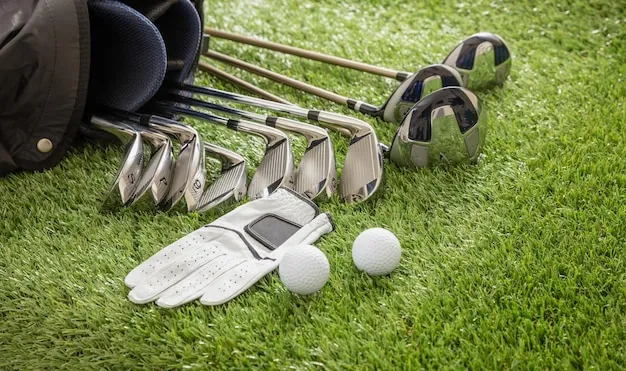
You do not require a driver that costs you 500 dollars to begin with. But you need the right stuff.
Clubs That Fit You
When you are a lefty, you should have left-handed clubs. That seems self-evident, yet I have witnessed attempts by people to swing on the right side since that is what a friend lent out to him. Don't do it. In addition to this, ensure that the clubs fit your height. Misery can be avoided in months with a simple visit to a local shop to get a primitive fitting.
Comfortable Shoes and Rain Gear
You will be walking a lot. Comfortable shoes matter. Furthermore, carry an umbrella in your bag. Weather changes fast.
What to Keep in Your Bag
- Extra balls and tees
- A divot repair tool and ball marker.
- Sunscreen and a hat
- Candy and juice (golf makes you thirsty)
Expert Q&A: Questions I Had as a Beginner
I posed some questions to the pros and experienced players which I was too ashamed to ask.
How Long Does It Take to Play 9 Holes?
According to Dan Brown, it takes an average of two hours. Don't rush. Enjoy the walk. The experience is more important than the score.
How Do I Take a Divot?
You don't smash the ground. You strike the ball with the first swing of the club and the second swing of the club strikes the grass. Imagine it as stomping the grass when you kick the ball.
How Do I Break 100?
Focus on your short game. Provided you can hit the ball inside 50 yards of the green in two or three strokes, and then putt in two, you can not miss 100 easily. You do not have to get the ball 300 yards.
My Final Advice for New Golfers
Golf is hard. It will humble you. But it will also make you some of the best days of your life. I recall how I had hit a pure iron shot the first time. It was a sharp strike, the ball came out in a straight line and fell softly on the green. I was a pro in that I lasted about five seconds. The thing is that emotion makes me want to return.
Be patient, however, do not get frustrated. Celebrate the small wins. A good putt. A solid drive. A great chip. All these are indicators that you are improving. Believe me, you know I can learn this game. I was the man who hit the first tee twenty yards in the air. Now? I still top it sometimes. But I also make surprising hits as well.